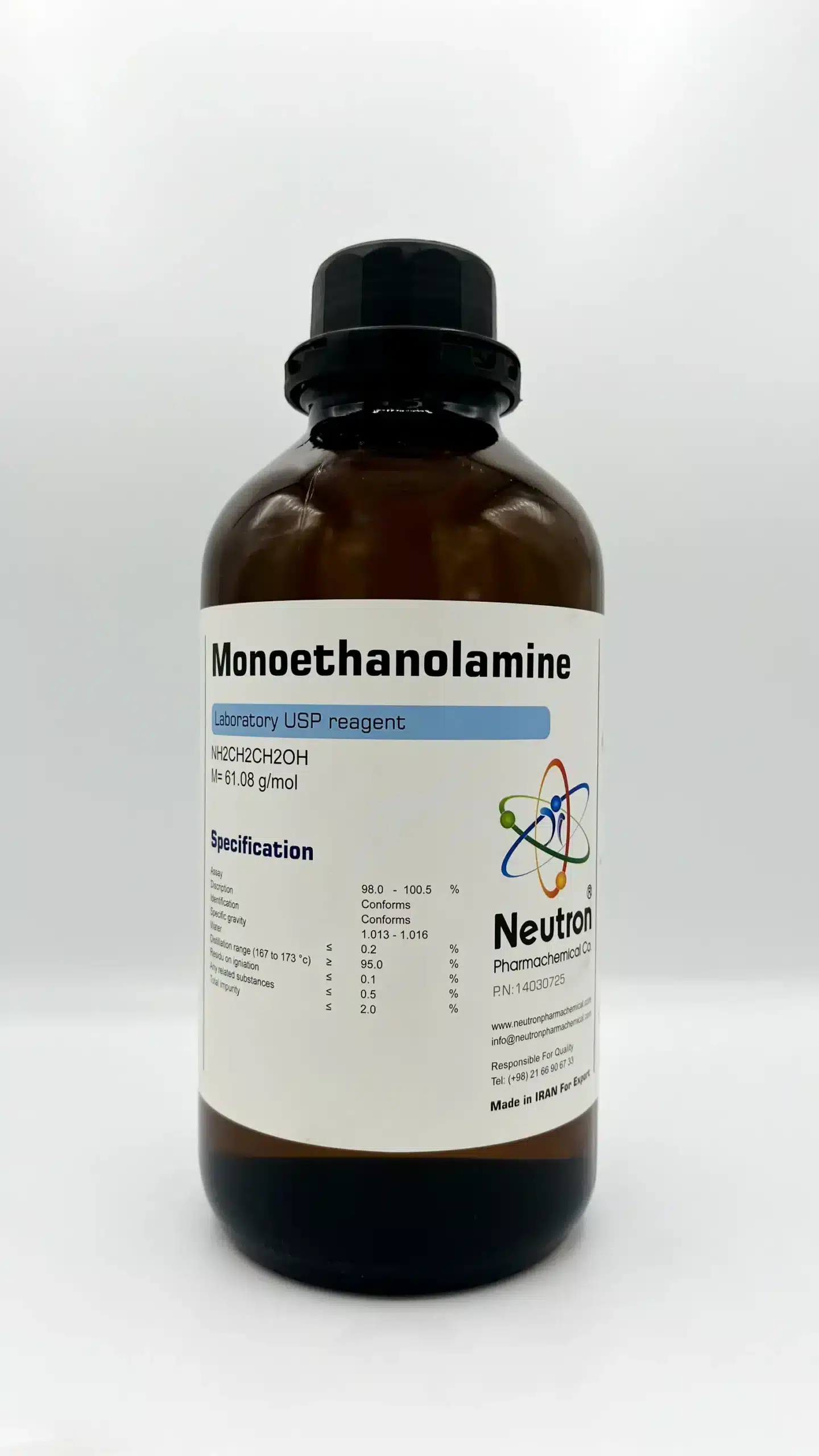
مونواتانول آمین
| Formula | C2H7NO |
| Chemical formula | NH2CH2CH2OH |
| Density | ~ 1.02 g/cm3 (20°c) |
| Molar mass | 61.08 g/mol |
| CAS number | 141-43-5 |
| HS Code | 29221100 |
| EC number | 205-483-3 |
| Storage | Store at 15 to 25 ° c |
| SDS | available |
| R phrase | R 20/21/22-34 |
| S phrase | S 26-36/37/39-45 |
| Odour | slightly of ammonia |
| Form | liquid |
| Color | colourless |
| Explosion limit | 3.4 to 27 vol % |
| Ignition temprature | 410°C |
| pHvalue | ~12.1(100 g/l 20 ° C) |
| Solubility in water | soluble |
| Flash point | 92.5 °C |
| Melting point | 10.5°C |
| Boiling point | 171 °C |
| Vapur pressure | 0.5 hPa (25°c) |
| Viscosity dynamical | 20 mPa*s (30°c) |
| Assay | 98.0 – 100.5 | % | |
| Discription | Conforms | ||
| Identification | Conforms | ||
| Specific gravity | 1.013 – 1.016 | ||
| Water | ≤ | 0.2 | % |
| Distillation range (167 to 173 °c) | ≥ | 95.0 | % |
| Residu on igniation | ≤ | 0.1 | % |
| Any related substances | ≤ | 0.5 | % |
| Total impurity | ≤ | 2.0 | % |
Monoethanolamine (MEA), also known as 2-aminoethanol, is an organic chemical compound that functions as both a primary amine and a primary alcohol. It appears as a colorless, viscous liquid with an ammonia-like odor. It is widely used in industrial processes, gas treatment, and personal care products.
🏭⚗️ Production
Monoethanolamine is produced industrially by reacting ethylene oxide with ammonia. The process also yields diethanolamine (DEA) and triethanolamine (TEA), depending on the reaction conditions and molar ratios.
🔬 Properties
MEA is a hygroscopic, water-soluble liquid with both basic and nucleophilic properties. It has the ability to neutralize acids and is commonly used to absorb acidic gases like CO₂ and H₂S. It is corrosive in concentrated form and can form stable emulsions.
🧪 Applications
• Gas treatment: Used to remove acidic gases (like CO₂ and H₂S) from natural gas and refinery streams in amine gas treating processes.
• Chemical manufacturing: Used as an intermediate in the production of detergents, emulsifiers, pharmaceuticals, and herbicides.
• Cosmetics and personal care: Functions as a pH adjuster and emulsifier in creams, shampoos, and lotions.
• Cleaning products: Common in household and industrial cleaners due to its degreasing and emulsifying properties.