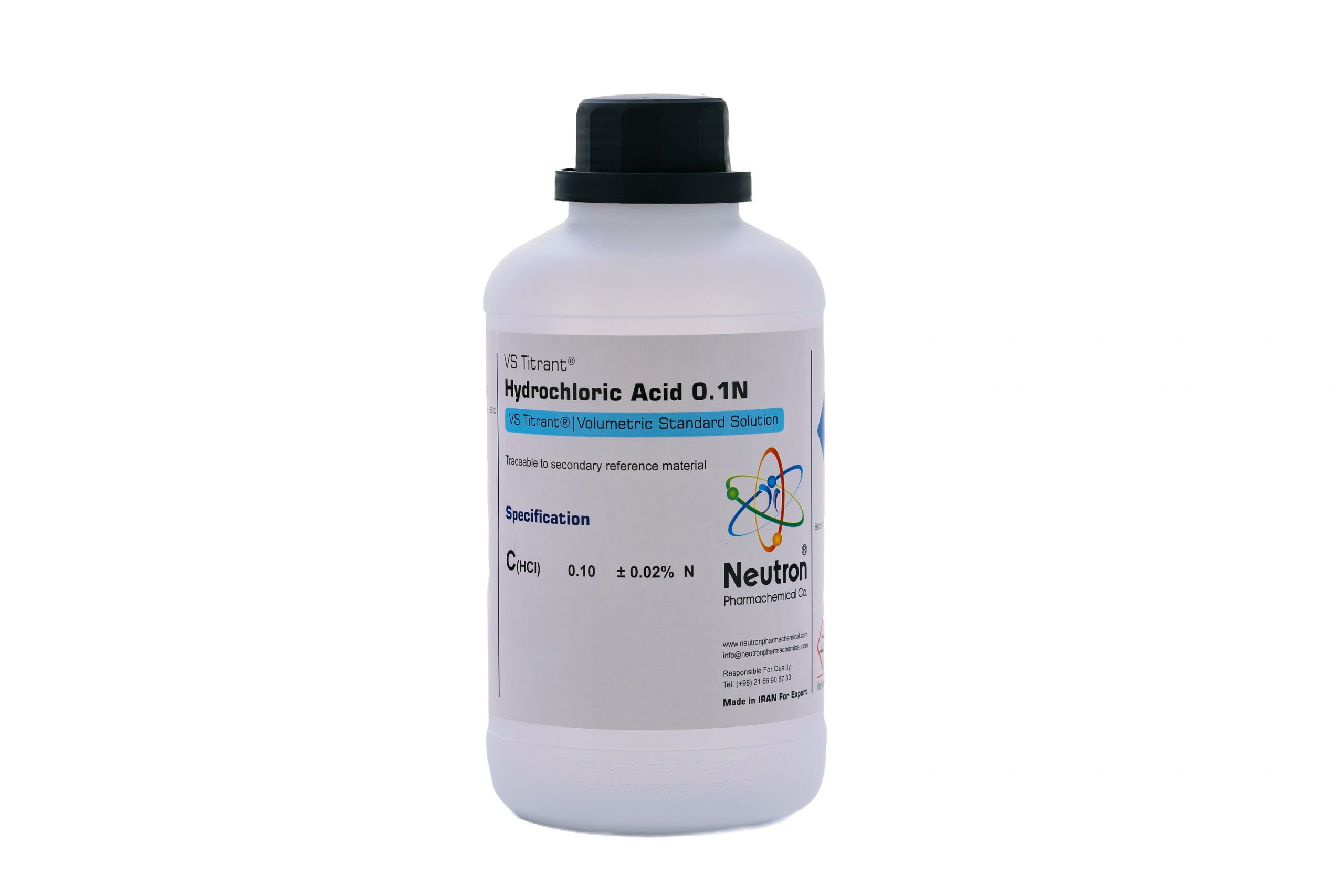
محلول اسید هیدروکلریک 0.1N
| Density: | 1.0 g/cm3 (20 ˚C) |
| HS code: | 28061000 |
| Storage: | Store at +15 ˚C to +25 ˚C |
| SDS | available |
| Odour: | odourless |
| Form: | liquid |
| Color: | colourless |
| Solubility in water: | (20 ˚C) soluble |
| C(HCl) | 0.10 | ± 0.02% N |
Hydrochloric Acid Solution 0.1 N is a standardized aqueous solution of hydrogen chloride (HCl) with a normality of 0.1 N, specifically formulated for analytical, laboratory, and pharmaceutical applications where precise acidity is required for volumetric analysis and assay procedures.
🏭⚗️ Production
Hydrochloric Acid Solution 0.1 N is prepared by carefully diluting concentrated hydrochloric acid with distilled or deionized water and standardized against a primary standard such as sodium carbonate to achieve accurate normality at 25°C. The solution is stored in tightly sealed, chemically resistant containers to prevent evaporation and maintain concentration stability over time.
🔬 Properties
The solution is a clear, colorless liquid with a sharp, characteristic odor. It is completely miscible with water and exhibits strong acidic properties. Hydrochloric Acid Solution 0.1 N remains stable under normal laboratory conditions if protected from heat and contamination, though it may release hydrogen chloride vapors if exposed to air.
🧪 Applications
In laboratory and pharmaceutical environments, Hydrochloric Acid Solution 0.1 N is used for acid-base titrations, pH adjustments, and standardization of alkaline solutions. It is also employed in assay procedures for active pharmaceutical ingredients, determination of alkalinity, and quality control testing to ensure compliance with pharmacopeial standards.
⚠️ Safety
The solution is corrosive and can cause burns upon contact with skin, eyes, or mucous membranes. Appropriate protective equipment such as gloves, goggles, and lab coats should be worn during handling. The solution should be stored in a cool, well-ventilated area, away from bases, oxidizing agents, and metals. In case of contact, affected areas should be rinsed immediately with copious amounts of water. Disposal of the solution must comply with institutional safety guidelines and local environmental regulations.