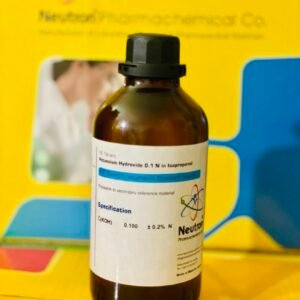
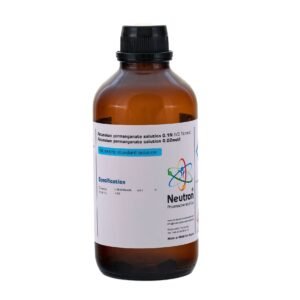
سدیم متوکساید 0.5 نرمال در متانول
Sodium Methoxide 0.5 N in Methanol is a standardized, moisture-sensitive alkaline reagent prepared as a 0.5 N (0.5 M) solution of sodium methoxide in anhydrous methanol. It provides a consistent and reactive non-aqueous base for analytical and synthetic applications in chemical, pharmaceutical, and biofuel laboratories where controlled basicity and water-free conditions are essential.
🏭⚗️ Production
Sodium Methoxide 0.5 N in Methanol is produced by dissolving high-purity sodium methoxide in dry methanol under inert atmosphere to prevent hydrolysis and carbonation. The solution is standardized to 0.5 N through volumetric titration and filtered to ensure clarity and uniform concentration. It is filled and sealed in moisture-resistant containers under dry nitrogen or argon to maintain stability and purity during storage and handling.
🔬 Properties
This reagent forms a clear, colorless to slightly yellow solution with a strong, characteristic methanolic odor. Chemically represented as CH₃ONa, sodium methoxide has a molar mass of 54.02 g/mol and acts as a strong non-aqueous base. The methanol solvent has a boiling point of approximately 64.6 °C and a density near 0.79 g/cm³. Sodium methoxide reacts violently with water and carbon dioxide, forming sodium hydroxide and sodium carbonate, and must therefore be kept completely dry.
🧪 Applications
Sodium Methoxide 0.5 N in Methanol is widely used as a strong base and catalyst in organic synthesis, supporting reactions such as deprotonation, condensation, methylation, and transesterification. It serves as a key catalyst in biodiesel production through the transesterification of triglycerides with methanol. In pharmaceutical and fine chemical laboratories, it is employed for base-catalyzed transformations requiring anhydrous, alcoholic conditions, and in analytical chemistry, it functions as a standardized titration reagent for quantitative analysis.
⚠️ Safety
Sodium Methoxide 0.5 N in Methanol is highly flammable, corrosive, and toxic. It can cause severe burns to the skin and eyes and is harmful if inhaled, ingested, or absorbed through the skin. The solution must be handled only in a well-ventilated fume hood while wearing protective gloves, goggles, and appropriate laboratory clothing. It should be stored tightly sealed in a cool, dry place away from air, moisture, and ignition sources. Waste and residues must be disposed of as hazardous material according to laboratory safety regulations.