سدیم سالیسیلات
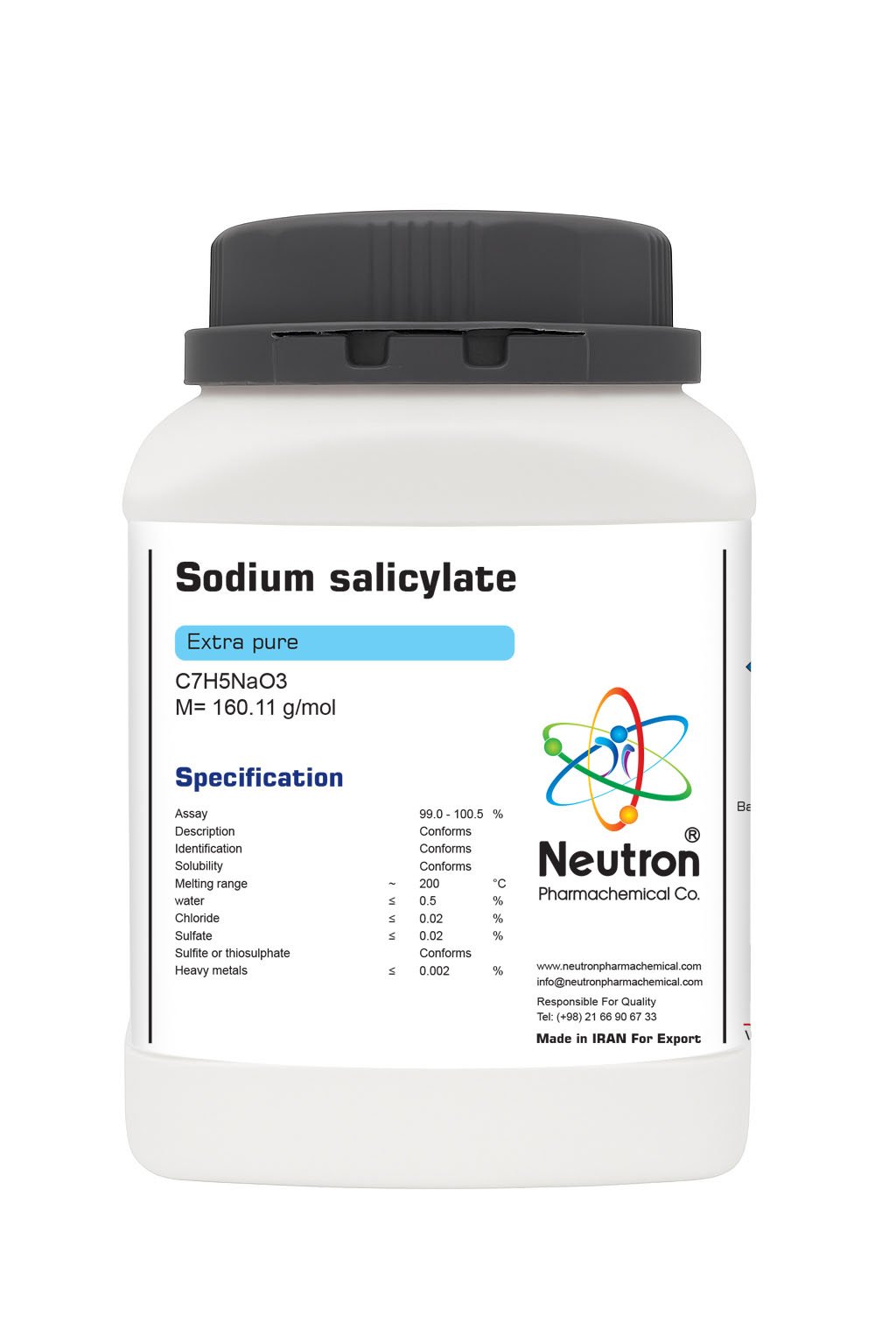
| Formula | C7H5NaO3 |
| Chemical formula | HOC6H4COONa |
| Molar mass | 160.11 g/mol |
| Bulk density | ~ 320 kg/m3 |
| CAS number | 54-21-7 |
| HS Code | 29182100 |
| EC number | 200-198-0 |
| Storage | Without limitation |
| SDS | available |
| R phrase | R 22-36 |
| S phrase | S 22-24 |
| Odour | odourless |
| Form | solid |
| Color | white |
| Ignition temperature | > 250 |
| p H value | ~6.5 (100 g/l 20 °C) |
| Solubility in water | ~1000 g/l (20°C) |
| Solubility in ethanol | soluble(20°C) |
| Melting point | 200 ºC |
| Vapour pressure | low |
| Assay | 99.0 – 100.5 | % | |
| Description | Conforms | ||
| Identification | Conforms | ||
| Solubility | Conforms | ||
| Melting range | ~ | 200 | °C |
| water | ≤ | 0/5 | % |
| Chloride | ≤ | 0/02 | % |
| Sulfate | ≤ | 0/02 | % |
| Sulfite or thiosulphate | Conforms | ||
| Heavy metals | ≤ | 0/002 | % |
Sodium salicylate is the sodium salt of salicylic acid, with the chemical formula C₇H₅NaO₃. It appears as a white, crystalline powder and is known for its analgesic, antipyretic, and anti-inflammatory properties. It has been historically used as a non-steroidal anti-inflammatory drug (NSAID).
🏭⚗️ Production
Sodium salicylate is commonly produced by neutralizing salicylic acid with sodium hydroxide or sodium carbonate. The reaction yields a water-soluble salt, which is then crystallized and dried for pharmaceutical or industrial use.
🔬 Properties
Sodium salicylate is a white, odorless powder that is highly soluble in water and alcohol. It has a bitter taste and is chemically stable under normal storage conditions. It functions as an anti-inflammatory and antipyretic agent, similar to aspirin, but is less irritating to the stomach lining.
🧪 Applications
• Pharmaceuticals: Used to relieve mild to moderate pain, fever, and inflammation. It was historically a precursor to aspirin and remains in use for certain conditions.
• Dermatology: Applied topically for its keratolytic and antiseptic properties in skin treatments.
• Laboratory reagent: Used in chemical research and analysis involving salicylates.
• Dye and chemical synthesis: Occasionally employed in organic synthesis and as an intermediate in dye manufacturing.