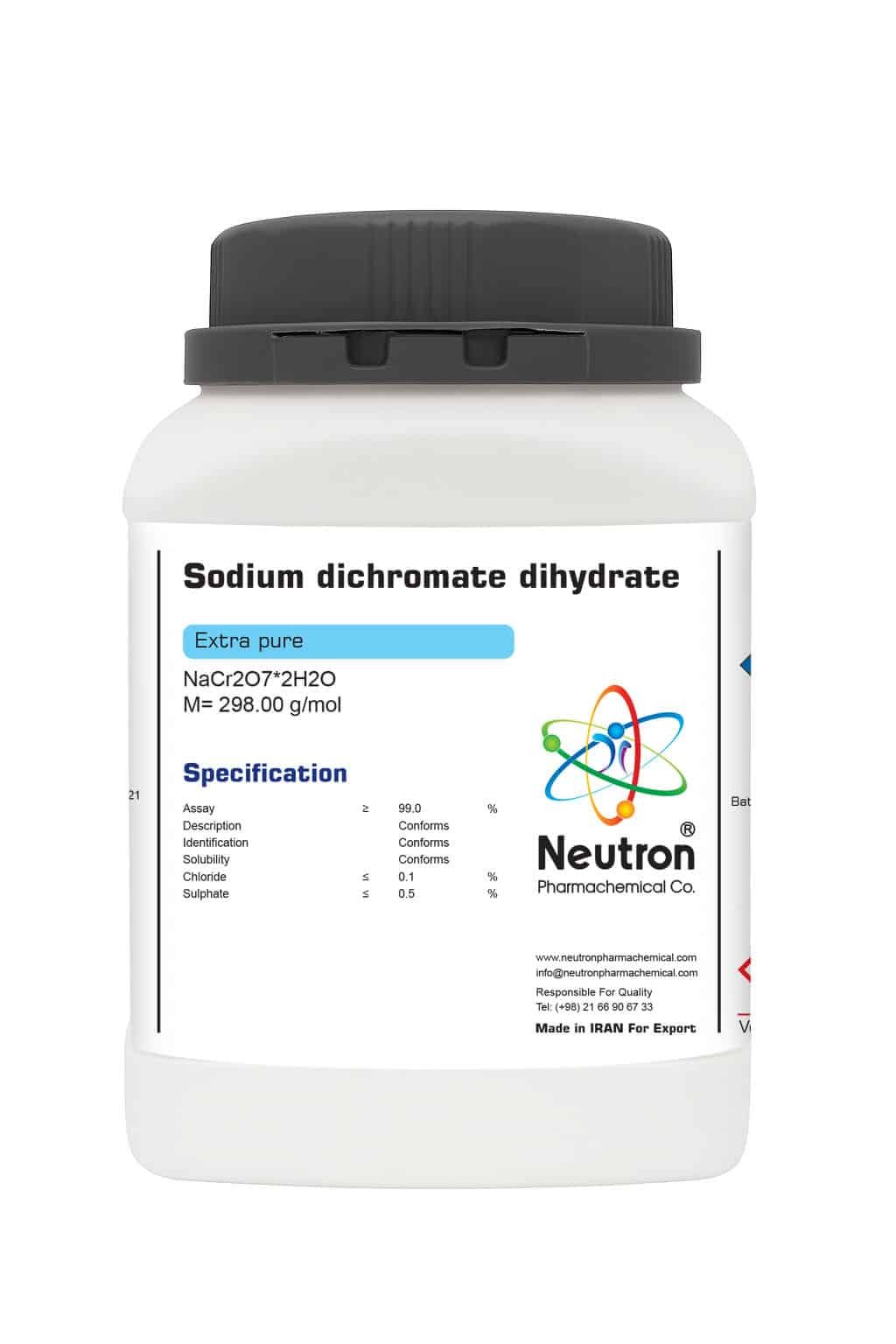
سدیم دی کرومات دی هیدرات
| Formula | Cr2Na2O7*2H2O |
| Chemical formula | NaCr2O7*2H2O |
| Density | 2.35 g/cm3 (20°C) |
| Molar mass | 298.00 g/mol |
| Bulk density | ~1200 kg/m3 |
| CAS number | 7789-12-0 |
| HS Code | 28413000 |
| EC number | 234-190-3 |
| Storage | Without limitation |
| SDS | available |
| RTECS | HX7750000 |
| R phrase | R 45-46-60-61-8-E21 |
| S phrase | S 53-45-60-61 |
| Odour | almost odourless |
| Form | crystals |
| Color | orange |
| p H | 3.5 (100g/l 20 °C) |
| Solubility in water | 731.8 g/l (20°C) |
| Solubility in ethanol | insoluble(20°C) |
| Melting point | 356.7 °C |
| Thermql decomposition | 400°C |
| Boiling point | 400°C |
| Assay | ≥ | 99 | % |
| Description | Conforms | ||
| Identification | Conforms | ||
| Solubility | Conforms | ||
| Chloride | ≤ | 0.1 | % |
| Sulphate | ≤ | 0.5 | % |
Sodium dichromate dihydrate is an orange-red crystalline inorganic compound widely used in chemical laboratories and industrial processes, particularly known for its strong oxidizing properties and use in analytical chemistry.
🏭⚗️ Production
Sodium dichromate dihydrate is typically produced by oxidizing chromium ores such as chromite with sodium carbonate in the presence of oxygen at high temperatures, followed by crystallization from aqueous solutions. The dihydrate form contains two molecules of water of crystallization, giving it distinct physical properties compared to the anhydrous form.
🔬 Properties
The chemical formula is Na₂Cr₂O₇·2H₂O, with a molar mass of approximately 298.00 g/mol. It appears as bright orange-red crystals that are soluble in water, forming strongly acidic solutions. Sodium dichromate dihydrate has a melting point of about 200 °C (decomposes), and it exhibits strong oxidizing behavior. It is toxic, corrosive, and harmful to the environment.
🧪 Applications
In laboratory and pharmaceutical contexts, sodium dichromate dihydrate is used as a powerful oxidizing agent in organic synthesis and analytical chemistry. It serves in the oxidation of alcohols to ketones and aldehydes, and in the cleaning and etching of laboratory glassware. It is also employed in photography, leather tanning, and pigment production. Despite its effectiveness, its use in pharmaceutical manufacturing is limited due to toxicity and environmental concerns.
⚠️ Safety
Sodium dichromate dihydrate is highly toxic, carcinogenic, and corrosive. It poses serious health risks through inhalation, ingestion, or skin contact, including respiratory tract irritation, skin ulcers, kidney damage, and increased risk of cancer. It is classified as a Group 1 carcinogen by IARC. Proper personal protective equipment, including gloves, lab coats, goggles, and working under a fume hood, is mandatory during handling. Disposal must comply with hazardous waste regulations to prevent environmental contamination.