زینک اکساید
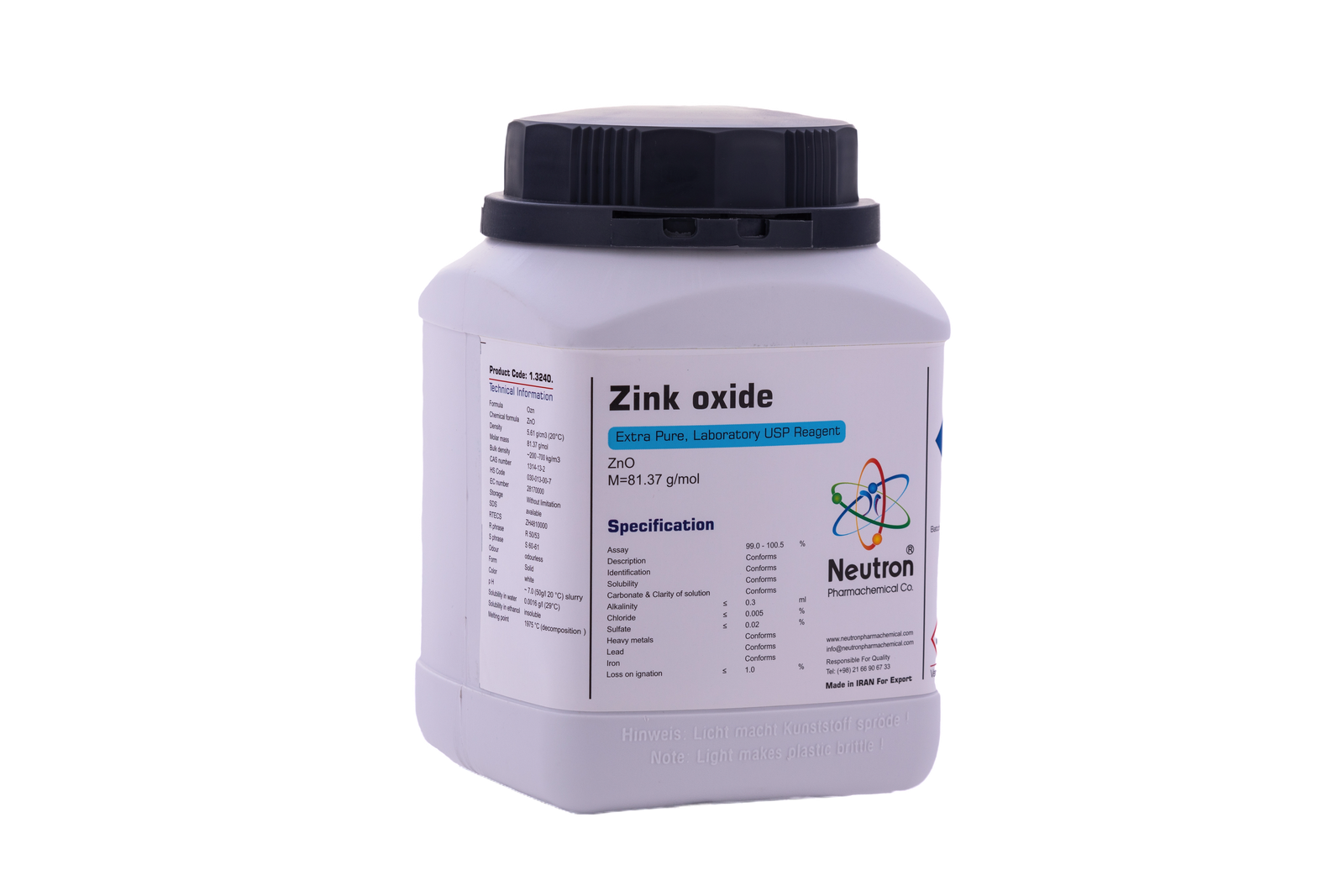
| Formula | Ozn |
| Chemical formula | ZnO |
| Density | 5.61 g/cm3 (20°C) |
| Molar mass | 81.37 g/mol |
| Bulk density | ~200 -700 kg/m3 |
| CAS number | 1314-13-2 |
| HS Code | 030-013-00-7 |
| EC number | 28170000 |
| Storage | Without limitation |
| SDS | available |
| RTECS | ZH4810000 |
| R phrase | R 50/53 |
| S phrase | S 60-61 |
| Odour | odourless |
| Form | Solid |
| Color | white |
| p H | ~ 7.0 (50g/l 20 °C) slurry |
| Solubility in water | 0.0016 g/l (29°C) |
| Solubility in ethanol | insoluble |
| Melting point | 1975 °C (decomposition ) |
| Assay | 99.0 – 100.5 | % | |
| Description | Conforms | ||
| Identification | Conforms | ||
| Solubility | Conforms | ||
| Carbonate & Clarity of solution | Conforms | ||
| Alkalinity | ≤ | 0.3 | ml |
| Chloride | ≤ | 0.005 | % |
| Sulfate | ≤ | 0.02 | % |
| Heavy metals | Conforms | ||
| Lead | Conforms | ||
| Iron | Conforms | ||
| Loss on ignation | ≤ | 1 | % |
Zinc oxide is a white, odorless, inorganic powder widely used in cosmetics, rubber production, ceramics, and pharmaceuticals for its protective, antibacterial, and UV-absorbing properties.
🏭⚗️ Production
It is typically produced by the direct (American) process using metallic zinc and oxygen, or by the indirect (French) process involving the vaporization of zinc metal followed by oxidation, as well as from zinc ores through roasting.
🔬 Properties
The chemical formula is ZnO with a molar mass of approximately 81.38 g/mol. It appears as a white powder, is insoluble in water but soluble in acids and alkalis, and has high thermal and chemical stability. It also exhibits semiconducting and photocatalytic properties.
🧪 Applications
Zinc oxide is used in sunscreens, ointments, and calamine lotion for skin protection, in rubber manufacturing as an activator and UV protector, in ceramics and glass for improving thermal resistance, and in electronics as a semiconductor material. It is also used in paints, coatings, and fertilizers.
⚠️ Safety
Generally recognized as safe in controlled uses, but inhalation of fine dust may cause respiratory irritation. Prolonged exposure in industrial settings should be avoided. Use appropriate personal protective equipment such as dust masks and goggles, and store in a dry, ventilated place.