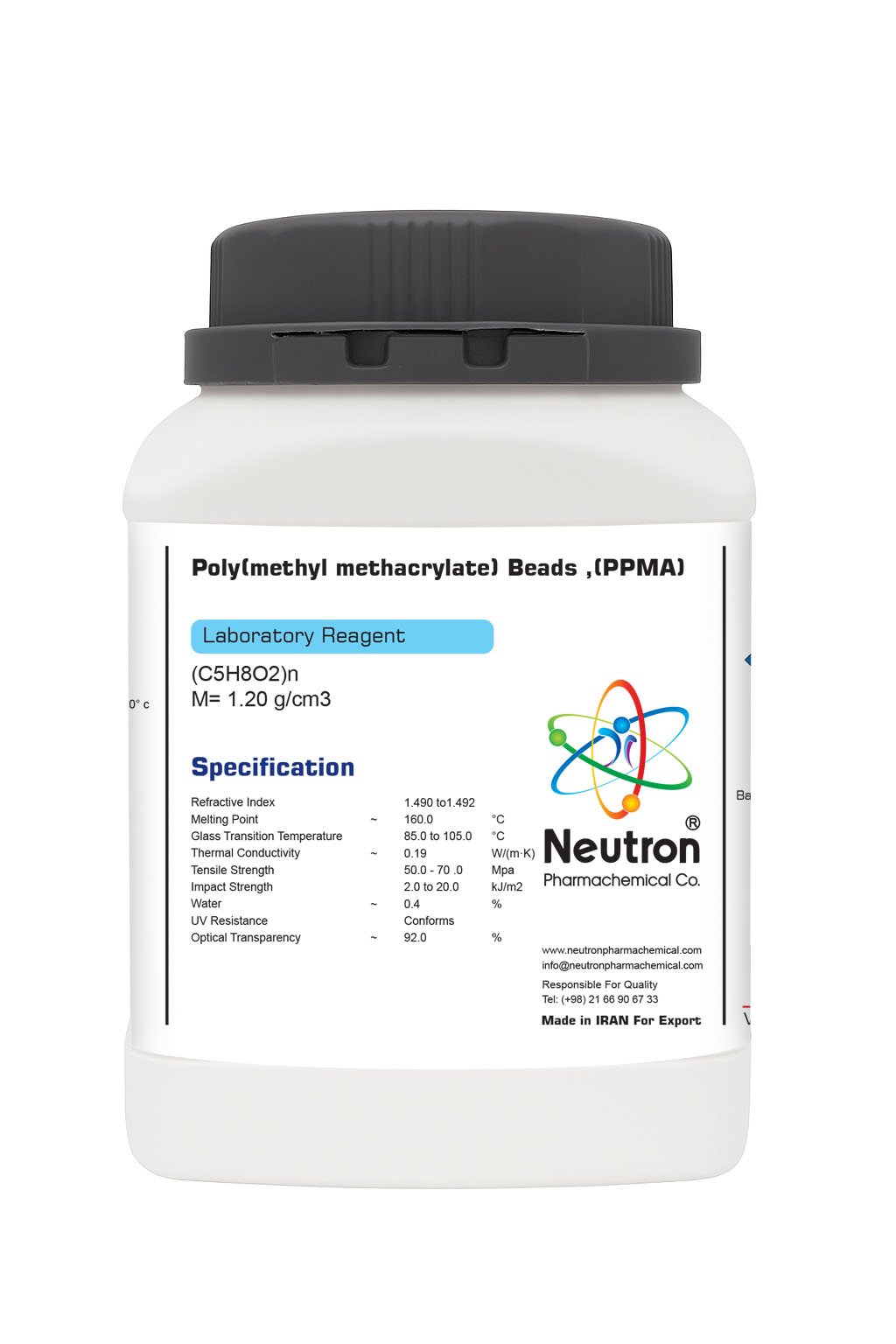
دانه های پلی (متیل متاکریلات)، (PPMA)
| Formula | (C5H8O2)n |
| Chemical formula | (C5H8O2)n |
| Density | 1.20 g/cm3 |
| CAS number | 9011-14-7 |
| HS Code | 29161410 |
| EC number | 201-297-1 |
| Storage | Store at 15 to 30° c |
| SDS | available |
| RTECS | OZ5075000 |
| R phrase | R 11-37/38-43 |
| S phrase | S 24-37-46 |
| Odour | characteristic |
| Form | solid beads |
| Color | colorless |
| Refractive Index | 1.490 to1.492 | ||
| Melting Point | ~ | 160.0 | °C |
| Glass Transition Temperature | 85.0 to 105.0 | °C | |
| Thermal Conductivity | ~ | 0.19 | W/(m·K) |
| Tensile Strength | 50.0 – 70 .0 | Mpa | |
| Impact Strength | 2.0 to 20.0 | kJ/m2 | |
| Water | ~ | 0.4 | % |
| UV Resistance | Conforms | ||
| Optical Transparency | ~ | 92.0 | % |
Poly(methyl methacrylate) Beads (PMMA) are spherical polymer particles composed of polymethyl methacrylate, a biocompatible thermoplastic material widely used in pharmaceutical and laboratory applications for its controlled-release, film-forming, and structural properties. The beads appear as clear to white spherical granules or powders that are insoluble in water but soluble in certain organic solvents.
🏭⚗️ Production
PMMA beads are produced by polymerizing methyl methacrylate monomers through suspension or emulsion polymerization under controlled temperature and pH conditions. The resulting microspheres are filtered, washed, and dried to obtain uniform, high-purity beads. For pharmaceutical and laboratory use, the particles are further standardized in size, molecular weight, and surface characteristics to ensure consistent performance in analytical and formulation systems.
🔬 Properties
PMMA beads are clear to white, odorless, and free-flowing spherical particles with excellent mechanical strength and optical clarity. They are insoluble in water but soluble in organic solvents such as chloroform, acetone, and toluene. Chemically, they are inert and stable under normal laboratory conditions. PMMA exhibits excellent film-forming and encapsulating properties, making it useful for creating protective coatings and sustained-release systems.
🧪 Applications
In pharmaceutical formulations, PMMA beads are used in controlled-release drug delivery systems, as matrix formers in sustained-release tablets, and as coating materials to regulate drug release rates. They are also utilized in ophthalmic applications, such as intraocular lenses, due to their optical clarity and biocompatibility. In laboratory settings, PMMA beads serve as calibration standards, chromatography supports, and carriers for immobilized enzymes or antibodies in biochemical assays.
⚠️ Safety
PMMA beads are generally regarded as safe and non-toxic for pharmaceutical and laboratory applications. However, fine particles may cause mechanical irritation if inhaled or come into contact with eyes. Appropriate protective equipment, including gloves, goggles, and dust masks, should be used during handling. The material should be stored in tightly sealed containers, in a cool, dry, and well-ventilated area, away from heat sources and direct sunlight, to maintain stability and performance.