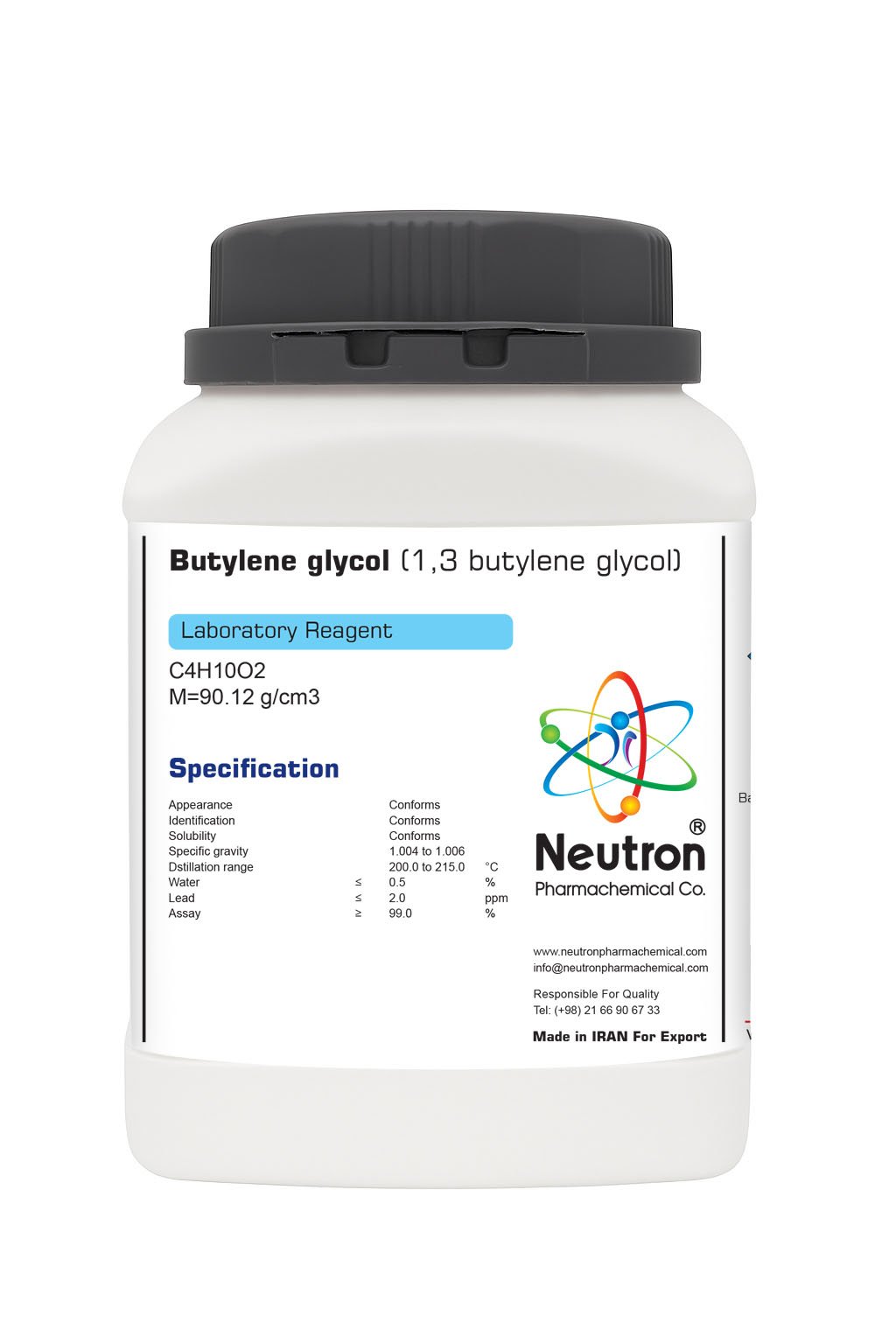
بوتیلن گلیکول
| formula | C4H10O2 |
| formula weight | 90.12 g/cm3 |
| CAS number | 107_88-0 |
| HS Code | 15131999 |
| Storage | Storage at 5 to 30 °C |
| SDS | available |
| Appearance | Conforms | ||
| Identification | Conforms | ||
| Solubility | Conforms | ||
| Specific gravity | 1.004 to 1.006 | ||
| Dstillation range | 200.0 to 215.0 | °C | |
| Water | ≤ | 0.5 | % |
| Lead | ≤ | 2.0 | ppm |
| Assay | ≥ | 99.0 | % |
Butylene Glycol is a synthetic organic compound widely used in pharmaceutical and laboratory applications for its solvent, humectant, and preservative-enhancing properties. It appears as a clear, colorless, viscous liquid with a mild odor and is highly soluble in water.
🏭⚗️ Production
Butylene glycol is produced through the catalytic hydrogenation of aldol using Raney nickel. This process yields a high-purity product suitable for pharmaceutical and laboratory applications.
🔬 Properties
Butylene glycol is a clear, colorless, viscous liquid with a mild odor. It is highly soluble in water and exhibits excellent solvent, humectant, and preservative-enhancing properties. The compound maintains its effectiveness under recommended storage conditions and is chemically stable.
🧪 Applications
In pharmaceutical formulations, butylene glycol is used as a solvent and cosolvent for injectables, topical ointments, creams, and lotions. It also serves as a vehicle in transdermal patches and is an effective solvent for many pharmaceuticals, especially estrogenic substances. In an oil-in-water emulsion, butylene glycol exerts its best antimicrobial effects at approximately 8% concentration. Higher concentrations above 16.7% are required to inhibit fungal growth. In laboratory settings, it is utilized in the preparation of emulsions, liposomes, and as a dispersant in various chemical reactions.
⚠️ Safety
Butylene glycol is generally considered safe for use in pharmaceutical and laboratory applications. However, it should be handled with care to avoid inhalation of vapors or prolonged skin contact. Appropriate personal protective equipment, including gloves and goggles, should be worn during handling. The compound is combustible when exposed to heat or flame and should be stored in a cool, dry, and well-ventilated area, away from sources of heat and moisture, to maintain its stability and effectiveness.