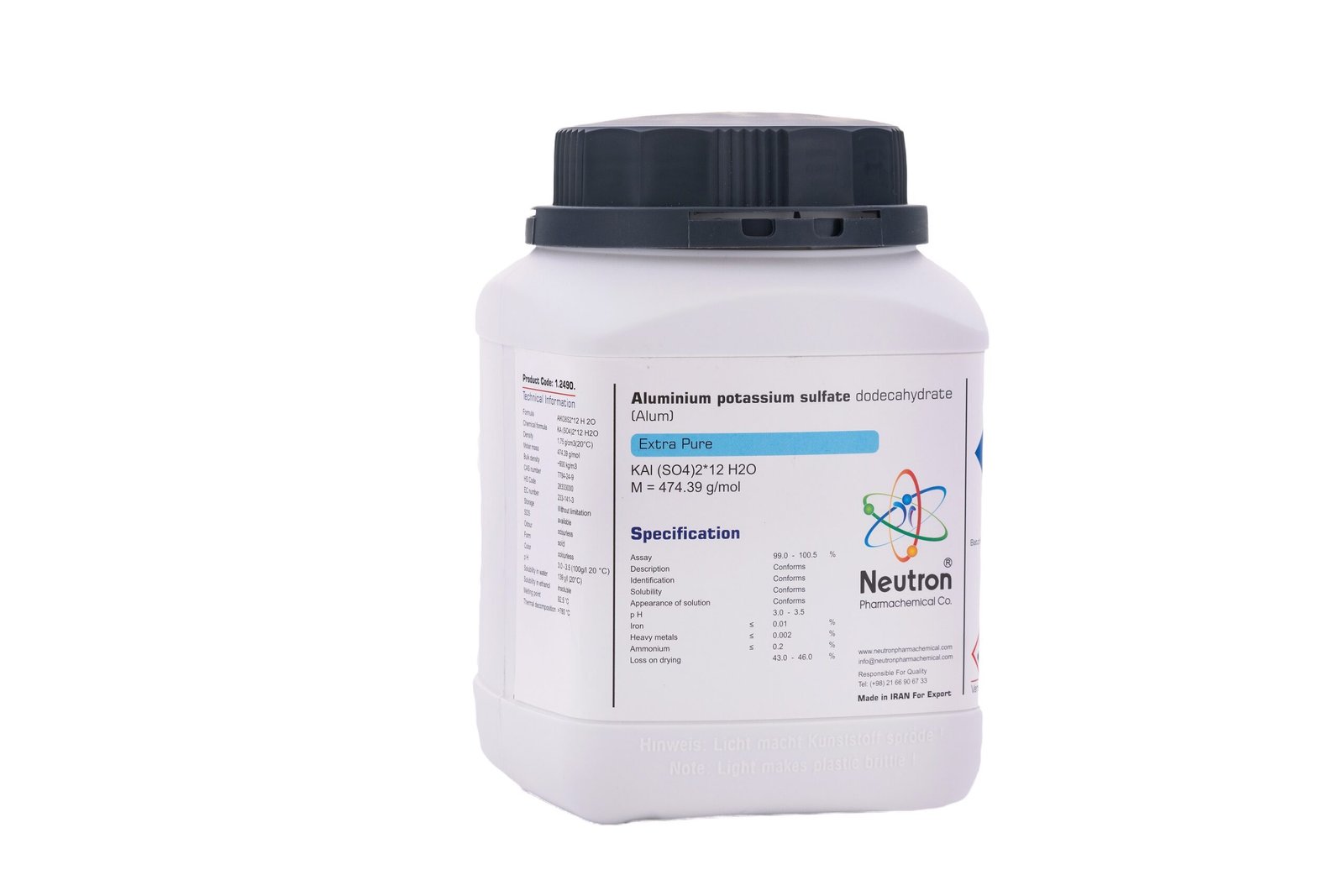
آلومینیوم پتاسیم سولفات 12 هیدراته
| Formula | AlKO8S2*12 H 2O |
| Chemical formula | KA (SO4)2*12 H2O |
| Density | 1.75 g/cm3(20°C) |
| Molar mass | 474.39 g/mol |
| Bulk density | ~900 kg/m3 |
| CAS number | 7784-24-9 |
| HS Code | 28333000 |
| EC number | 233-141-3 |
| Storage | Without limitation |
| SDS | available |
| Odour | odourless |
| Form | solid |
| Color | colourless |
| p H | 3.0 – 3.5 (100g/l 20 °C) |
| Solubility in water | 139 g/l (20°C) |
| Solubility in ethanol | insoluble |
| Melting point | 92.5 °C |
| Thermal decomposition | >780 °C |
| Assay | 99.0 – 100.5 | % | |
| Description | Conforms | ||
| Identification | Conforms | ||
| Solubility | Conforms | ||
| Appearance of solution | Conforms | ||
| p H | 3.0 – 3.5 | ||
| Iron | ≤ | 0/01 | % |
| Heavy metals | ≤ | 0/002 | % |
| Ammonium | ≤ | 0/2 | % |
| Loss on drying | 43.0 – 46.0 | % |
Aluminium potassium sulfate dodecahydrate is a colorless crystalline inorganic compound commonly known as potassium alum. It is widely used in water purification, cosmetics, and as a mordant in dyeing due to its astringent and antimicrobial properties.
🏭⚗️ Production
This compound is typically produced by reacting aluminum sulfate with potassium sulfate in water, followed by slow crystallization to form large, transparent dodecahydrate (12H₂O) crystals. It also occurs naturally as the mineral alunite, but industrial synthesis provides higher purity for commercial use.
🔬 Properties
The chemical formula is KAl(SO₄)₂·12H₂O with a molar mass of approximately 474.39 g/mol. It appears as large, transparent or white crystals that are soluble in water and slightly acidic in solution. It is stable at room temperature but loses water gradually when heated, eventually decomposing at high temperatures.
🧪 Applications
Aluminium potassium sulfate is widely used as a flocculant in water and wastewater treatment to remove suspended particles. In cosmetics, it is used in natural deodorants and aftershave products for its antiseptic and pore-tightening effects. It is also important in the textile industry as a mordant to fix dyes and in food (as E522) as a firming agent and acidity regulator.
⚠️ Safety
Generally recognized as safe in small quantities, but prolonged exposure to dust may cause eye or respiratory irritation. Ingestion of large amounts may lead to gastrointestinal discomfort. During handling, protective gloves and goggles are recommended. It should be stored in a dry, well-ventilated place away from strong acids and bases.