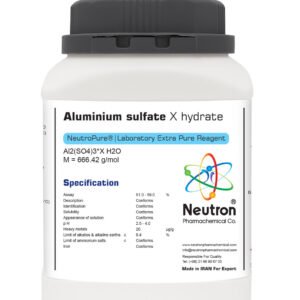
sodium thiosulphate pantahydrate
| Formula (Hill): | Na2O3S2*5 H2O |
| Density: | 1.74 g/cm3 (20 °C) |
| Molar mass: | 248.21 g/mol |
| Bulk density: | ~ 1000 kg/m3 |
| CAS number: | 10102-17-7 |
| HS code: | 28323000 |
| EC number: | 231-867-5 |
| Storage (temperature): | Without limitations. |
| SDS | Available |
| RTECS: | WE6660000 |
| Odour: | Odourless |
| Form: | Solid |
| Color: | Colourless |
| PH value: | 6.0 – 7.5 (100 g/l 20 °C) |
| Solubility in water: | 701 g/l (20 °C) |
| Solubility in ethanol: | Insoluble |
| Melting point: | 48 °C |
| Thermal decomposition: | 100 °C |
| Assay | 99.0 – 100.5 | % | |
| Description | Conforms | ||
| Solubility | Conforms | ||
| Identification | Conforms | ||
| Heavy metals | ≤ | 0/002 | % |
| Calcium | Conforms | ||
| Water | 32.0 – 37.0 | % |
Sodium thiosulfate pentahydrate is a colorless crystalline inorganic compound widely used for its reducing properties and ability to form complexes with heavy metals. It is commonly applied in photography, water treatment, and medicine.
🏭⚗️ Production
It is typically produced by reacting sodium sulfite with elemental sulfur in aqueous solution, followed by crystallization to yield the pentahydrate form. The crystallization process is carefully controlled to obtain pure, well-defined crystals suitable for industrial and laboratory use.
🔬 Properties
The chemical formula is Na₂S₂O₃·5H₂O with a molar mass of approximately 248.18 g/mol. It appears as colorless, odorless crystals that are highly soluble in water, forming neutral to slightly alkaline solutions. It is stable under normal storage but decomposes slowly when exposed to heat or acidic conditions, releasing sulfur dioxide and sulfur.
🧪 Applications
Sodium thiosulfate pentahydrate is widely used as a photographic fixer to dissolve unreacted silver halides from exposed film. It is also employed in water treatment to neutralize chlorine and heavy metals, and in medicine as an antidote for cyanide poisoning. Additionally, it serves in analytical chemistry for iodometric titrations and as a reducing agent in various industrial processes.
⚠️ Safety
This compound is generally considered safe under recommended handling but may cause mild irritation to skin and eyes upon contact. Inhalation of dust should be avoided to prevent respiratory discomfort. Use personal protective equipment such as gloves and goggles when handling, and store in a cool, dry place away from acids and strong oxidizers.