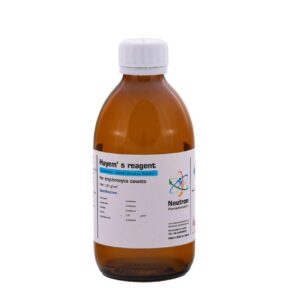
McFarland standard solution 1.0
| Density: | 1.02 g/cm3 |
| HS code: | 38220090 |
| Storage | Without limilations. |
| SDS | Available |
| Form | Liquid |
Before use, gently mix the buttle to ensure an even suspension.
Compare the bacterial suspension in a clear tube against the
McFarland 0.5 standard under adequate lighting.
Adjust the bacterial suspension by adding sterile saline or broth if the
turbidity is too high or adding more bacteria if the turbidity is too low.
Use the standardized bacterial suspension immediately for
antimicrobial susceptibility testing.
Notes:
This product is intended for laboratory use only and should not be
used for direct clinical diagnosis.
The McFarland standard must be stored in a light-protected area to
prevent degradation.
Over time, precipitation may occur; shake well before use to ensure
uniformit
McFarland Standard Solution 1.0 is a turbidity reference solution used in microbiology, primarily for standardizing bacterial suspensions before antimicrobial susceptibility testing.
🏭⚗️ Production
McFarland Standard 1.0 is prepared by mixing 0.1 mL of 1% barium chloride with 9.9 mL of 1% sulfuric acid. The reaction produces a fine precipitate of barium sulfate, creating a stable, turbid suspension. The solution is mixed thoroughly until uniform turbidity is achieved, transferred into a sealed, clear tube, and stored at room temperature protected from light to maintain its turbidity standard.
🔬 Properties
McFarland Standard 1.0 is a turbid, milky-white suspension that simulates the optical density of a bacterial culture containing approximately 3 × 10⁸ CFU/mL. It is chemically stable under normal storage conditions but requires shaking before use to redistribute the precipitate evenly.
🧪 Applications
This standard is commonly used to adjust the turbidity of bacterial suspensions before antimicrobial susceptibility testing, helping prepare inocula with standardized cell density for microbiological procedures.
⚠️ Safety
Handle with care; sulfuric acid is corrosive and barium chloride is toxic. Use gloves and eye protection, work in a well-ventilated area, and avoid ingestion and inhalation. Dispose of waste according to local chemical safety regulations.