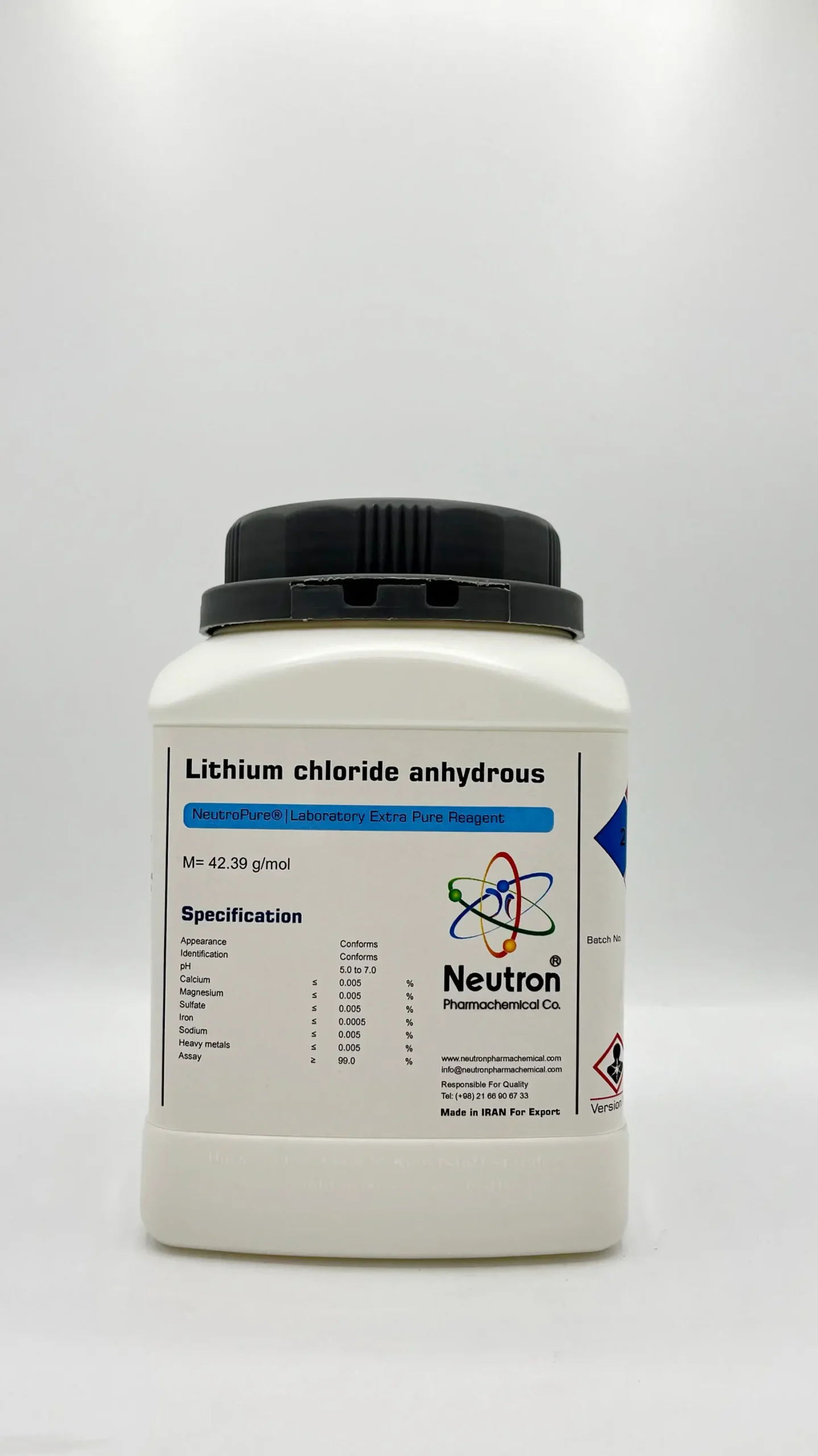
Lithium chloride anhydrous
| Chemical formula | LiCl |
| Molar Mass | 42.39 g/mol |
| CAS Number | 7447-41-8 |
| HS Code | 28273960 |
| Storage | Store below +30°C |
| SDS | available |
| RTECS | OJ5950000 |
| Boiling point | 1360 °C (1013 hPa) |
| Density | 2.07 g/cm3 (20 °C) |
| Melting Point | 608.52 °C |
| pH value | ~6.0 (HO, 20 °C) |
| Vapor pressure | 1.33hPa (20 °C) |
| Solubility | 569 g/l |
| Appearance | Conforms | ||
| Identification | Conforms | ||
| pH | 5.0 to 7.0 | ||
| Calcium | ≤ | 0.005 | % |
| Magnesium | ≤ | 0.005 | % |
| Sulfate | ≤ | 0.005 | % |
| Iron | ≤ | 0.0005 | % |
| Sodium | ≤ | 0.005 | % |
| Heavy metals | ≤ | 0.005 | % |
| Assay | ≥ | 99.0 | % |
Lithium chloride anhydrous is a white, crystalline, hygroscopic salt that is highly soluble in water and commonly used in industrial and laboratory applications. It is the anhydrous form of lithium chloride and is valued for its thermal stability and ability to absorb moisture from the air.
🏭⚗️ Production
Lithium chloride anhydrous is typically produced by the reaction of lithium carbonate or lithium hydroxide with hydrochloric acid, followed by evaporation and crystallization. To obtain the anhydrous form, the hydrated salt is further heated under vacuum or in a dry atmosphere to remove water. It can also be produced directly by the chlorination of lithium metal.
🔬 Properties
The chemical formula of lithium chloride anhydrous is LiCl, with a molar mass of approximately 42.39 g/mol. It appears as a white, odorless, crystalline solid. It has a melting point of about 605 °C and a boiling point of 1382 °C. Lithium chloride is highly soluble in water and also soluble in alcohols and some organic solvents. It is hygroscopic, meaning it readily absorbs moisture from the air, and is thermally stable under normal conditions.
🧪 Applications
Lithium chloride anhydrous is used in air conditioning and industrial drying systems as a desiccant. In organic synthesis, it serves as a reagent and catalyst in various reactions, including the formation of organolithium compounds. It is also used in the production of lithium metal through electrolysis, in molten salt chemistry, and in fluxes for aluminum processing. In spectroscopy and research, lithium chloride is used for its high ionic conductivity and compatibility with various solvents.
⚠️ Safety
Lithium chloride anhydrous should be handled with care, as it can cause irritation to the skin, eyes, and respiratory tract. Ingestion may be harmful and can affect the nervous system, kidneys, and cardiovascular function. Prolonged or repeated exposure should be avoided. Proper personal protective equipment, including gloves and eye protection, should be used. The compound should be stored in tightly sealed containers in a cool, dry environment to prevent absorption of moisture.