Ammonium dihydrogen phosphate
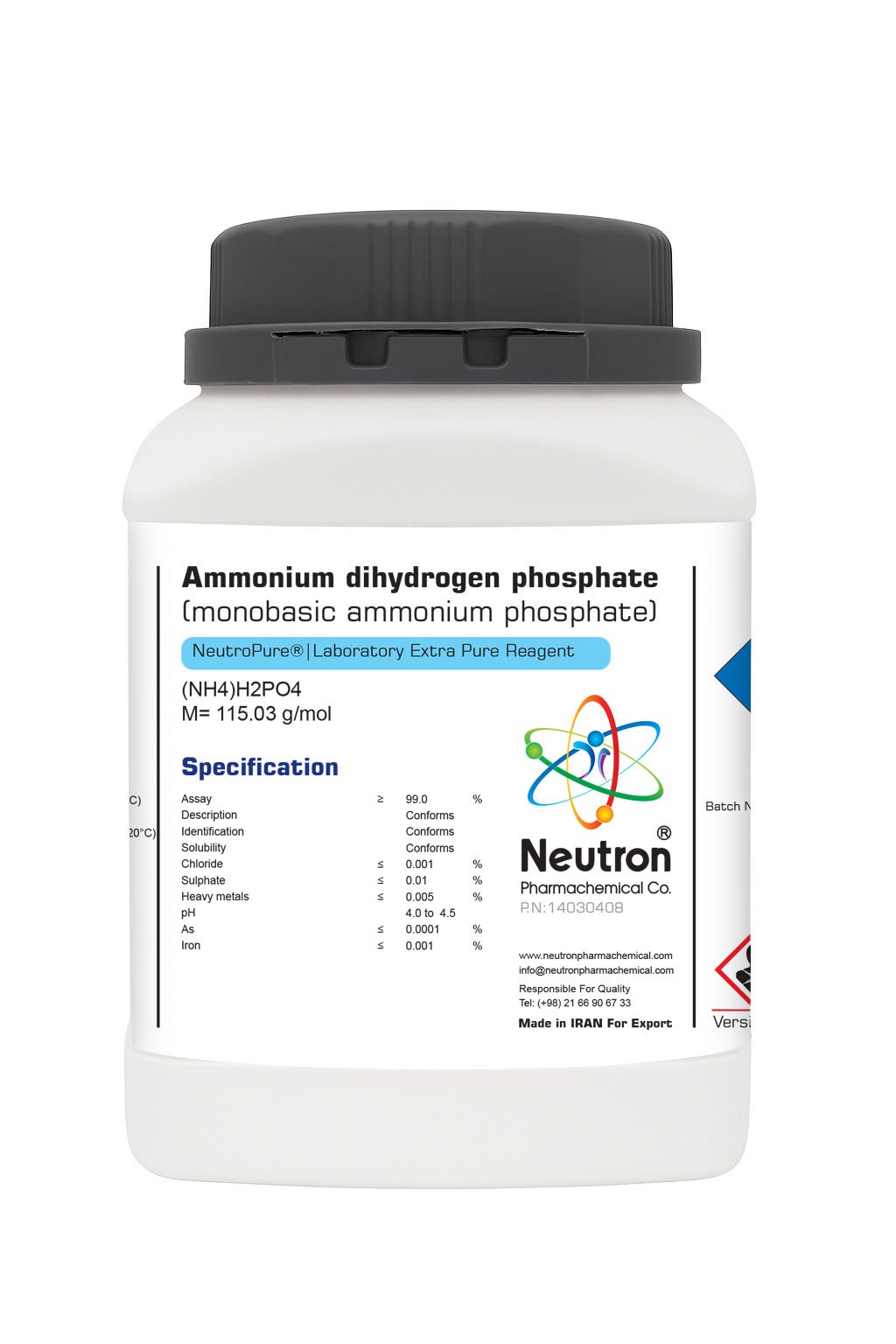
| Formula | H6NO4P |
| Chemical formula | (NH4)H2PO4 |
| Molar mass | 115.03 g/mol |
| CAS number | 7722-76-1 |
| HS Code | 31054000 |
| EC number | 231-764-5 |
| Storage | Without limitation |
| SDS | available |
| Odour | odourless |
| Form | solid |
| Color | colourless |
| p H value | 3.8 – 4.4(50 g/l 20°C) |
| Solubility in water | 368 g/l (20°c) |
| Solubility in ethanol | sparingly soluble (20°C) |
| Melting point | 190 °C |
| Vapour pressure | 0.066 hPa(125 °C) |
| Thermal decomposition | >190 °C |
| Assay | ≥ | 99 | % |
| Description | Conforms | ||
| Identification | Conforms | ||
| Solubility | Conforms | ||
| Chloride | ≤ | 0.001 | % |
| Sulphate | ≤ | 0/01 | % |
| Heavy metals | ≤ | 0/005 | % |
| pH | 4.0 to 4.5 | ||
| As | ≤ | 0/0001 | % |
| Iron | ≤ | 0/001 | % |
Ammonium dihydrogen phosphate is a white, crystalline inorganic compound commonly used as a fertilizer, flame retardant, and reagent in laboratories, valued for its content of nitrogen and phosphorus which are essential nutrients for plant growth.
🏭⚗️ Production
Ammonium dihydrogen phosphate (NH₄H₂PO₄) is typically produced by the reaction of ammonia (NH₃) with phosphoric acid (H₃PO₄) under controlled conditions; the resulting solution is concentrated and crystallized to yield solid monoammonium phosphate, which is then dried and sized for use in agricultural or technical applications.
🔬 Properties
The chemical formula is NH₄H₂PO₄ with a molar mass of approximately 115.03 g/mol. It appears as a white, odorless, crystalline powder or granules that is highly soluble in water and slightly acidic in solution (pH ~4.5). It decomposes on heating to form polyphosphates and releases ammonia gas; it is non-flammable, non-hygroscopic, and stable under normal storage conditions.
🧪 Applications
Ammonium dihydrogen phosphate is widely used in agriculture as a high-purity source of nitrogen and phosphorus in monoammonium phosphate (MAP) fertilizers. It is also used as a flame retardant in fire extinguishers (particularly dry chemical types), as a yeast nutrient in brewing and fermentation processes, in ceramics and optical crystal growth (e.g. ADP crystals), and as a buffering or reagent compound in chemical laboratories.
⚠️ Safety
Ammonium dihydrogen phosphate is generally considered to have low toxicity and is safe when handled appropriately; however, inhalation of dust may cause mild respiratory or throat irritation and contact with eyes or skin may cause slight irritation. Proper personal protective equipment such as gloves, goggles, and a dust mask should be used during handling. It should be stored in a cool, dry, well-ventilated area away from incompatible substances such as strong oxidizers or bases.