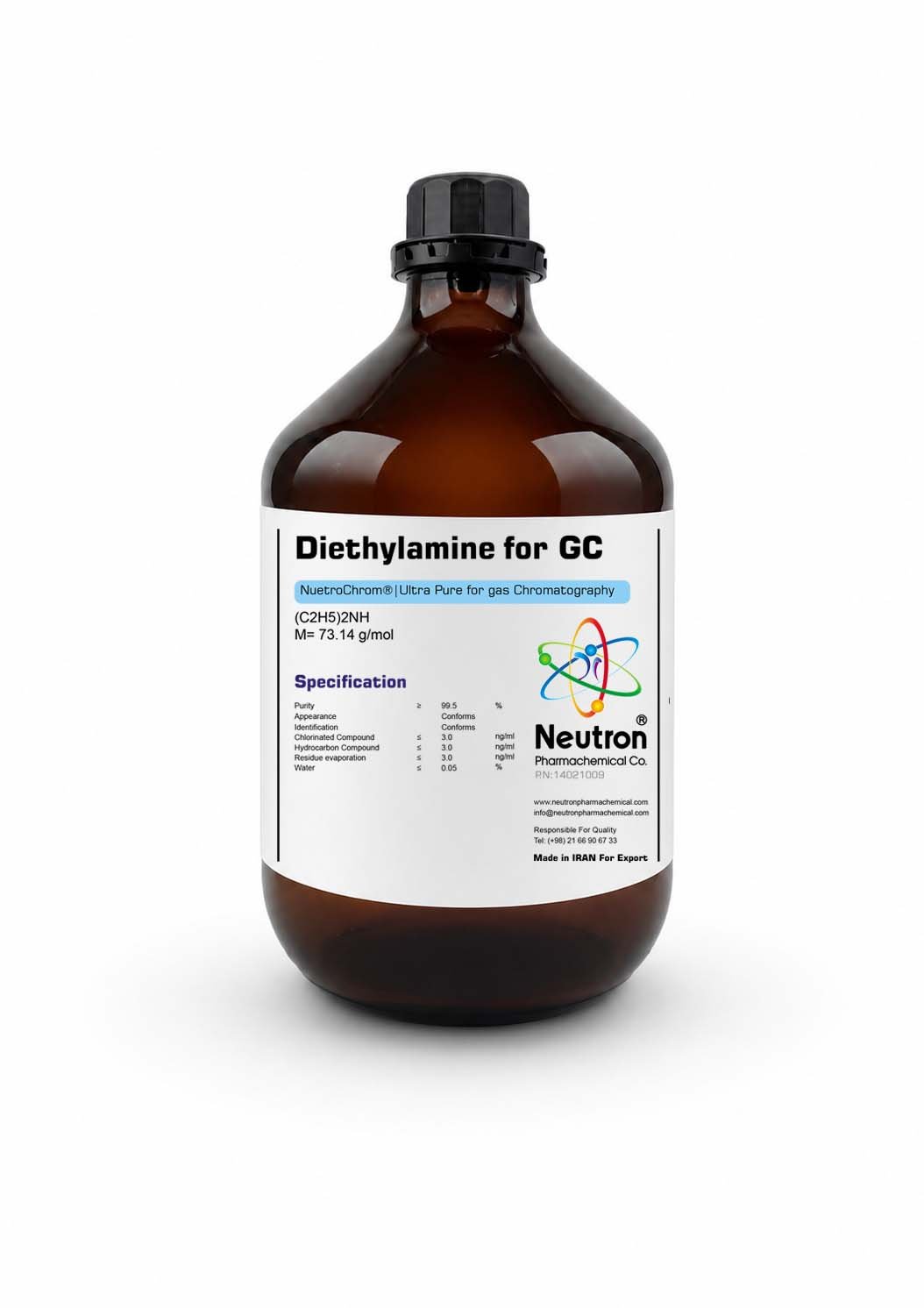
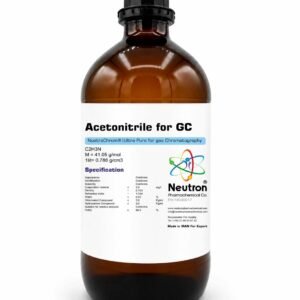
Diethylamine for GC
| Chemical formula | (C2H5)2NH |
| Molar Mass | 73.14 g/mol |
| CAS Number | 109-89-7 |
| HS Code | 2921 19 15 |
| Storage | Store below +30°C |
| SDS | available |
| RTECS | HZ8750000 |
| Explosion limit | 2.0 – 11.8 %(V) |
| Flash point | -26 °C |
| Ignition temperature | 290 °C |
| Boiling point | 56 °C (1013 mbar) |
| Density | 0.71 g/cm3 (20 °C) |
| Melting Point | -50 °C |
| pH value | 13 (100 g/l, HO, 20 °C) |
| Vapor pressure | 253 hPa (20 °C) |
| Purity | ≥ | 99.5 | % |
| Appearance | Conforms | ||
| Identification | Conforms | ||
| Chlorinated Compound | ≤ | 3 | ng/ml |
| Hydrocarbon Compound | ≤ | 3 | ng/ml |
| Residue evaporation | ≤ | 3 | ng/ml |
| Water | ≤ | 0.05 | % |
Diethylamine for GC is a high-purity aliphatic amine specifically refined for gas chromatography applications. It is widely used as a solvent, reagent, and intermediate in analytical, pharmaceutical, and chemical research, where low impurity levels and consistent volatility are critical for accurate and reproducible GC results.
🏭⚗️ Production
Manufactured through controlled alkylation of ammonia or ethylamine with ethanol or ethyl halides, followed by advanced fractional distillation and purification to achieve GC-grade quality. Special emphasis is placed on minimizing water content, non-volatile residues, and organic impurities that could interfere with chromatographic analysis. Each batch is rigorously tested for purity, boiling range, and chromatographic performance. Supplied in tightly sealed, chemically compatible containers under conditions that prevent moisture uptake and contamination.
🔬 Properties
Clear, colorless to pale yellow liquid with a strong, ammonia-like odor. Highly volatile and completely miscible with water and most organic solvents. Exhibits strong basicity and good electron-donating properties, making it suitable for derivatization and analytical reactions. Possesses a low boiling point, ideal for GC applications, but is hygroscopic and sensitive to air and carbon dioxide. Flammable and reactive with strong oxidizing agents.
🧪 Applications
Primarily used as a GC solvent and reagent in analytical laboratories, ensuring minimal background noise and high peak resolution. Employed in pharmaceutical and chemical analysis, derivatization reactions, and quality control testing. Also used as an intermediate in organic synthesis, agrochemicals, rubber accelerators, and corrosion inhibitors where analytical-grade purity is required.
⚠️ Safety
For laboratory use only. Flammable, corrosive, and strongly basic. Causes severe irritation or burns to skin and eyes; harmful if inhaled due to volatile vapors. Use only in well-ventilated areas or fume hoods. Handle with appropriate personal protective equipment, including chemical-resistant gloves, lab coat, and eye/face protection. Store in a tightly closed container in a cool, dry, well-ventilated place, away from heat sources, acids, and oxidizing agents. Dispose of in accordance with local chemical waste regulations.