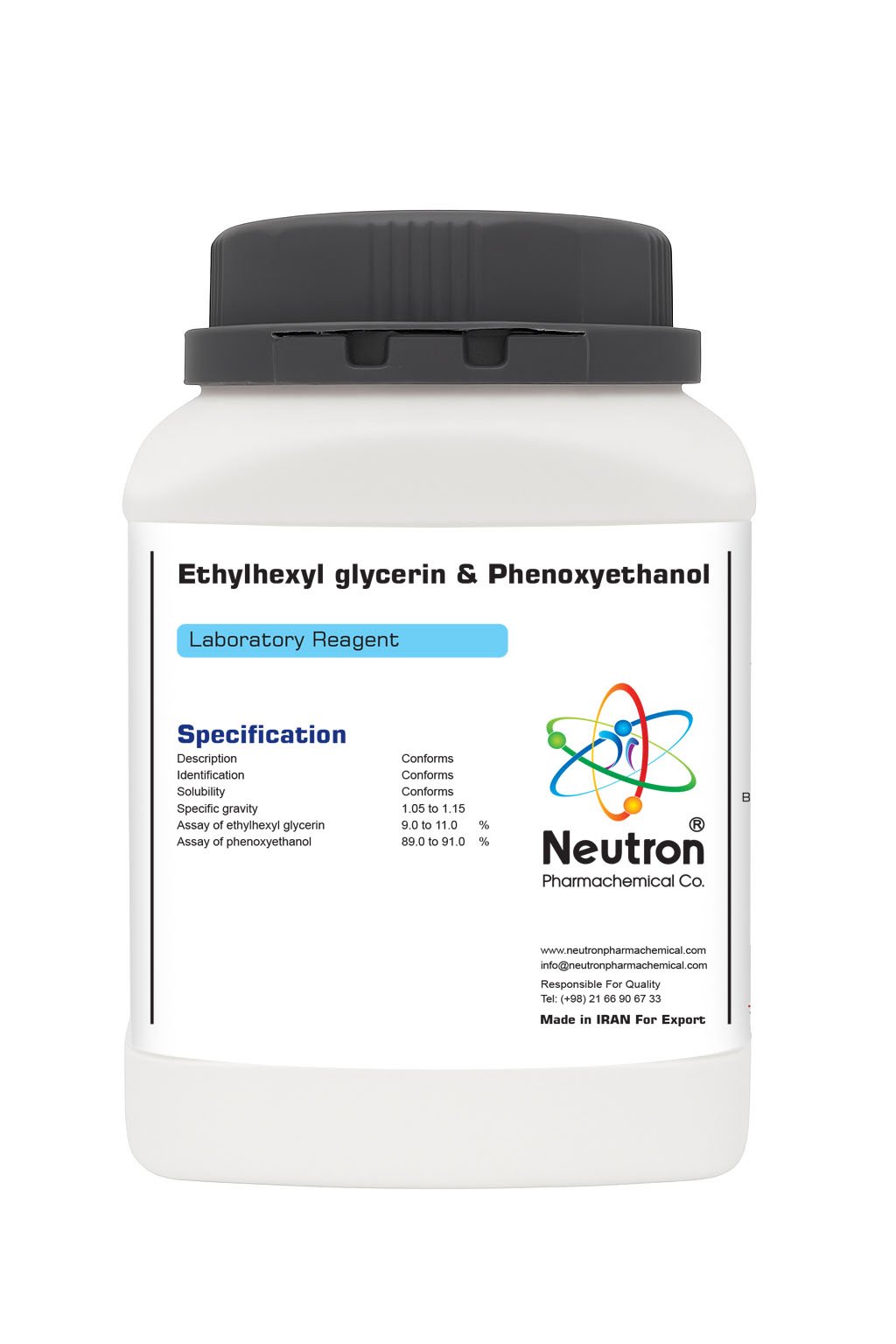
Phenoxyethanol & ethylhexylglycerin
| CAS number | 70445-33-9122-99-6 |
| HS Code | 29094900 |
| EC number | 204-589-7 |
| Storage | Storage at 5 to 30 °C |
| SDS | available |
| Description | Conforms | ||
| Identification | Conforms | ||
| Solubility | Conforms | ||
| Specific gravity | 1.05 to 1.15 | ||
| Assay of ethylhexyl glycerin | 9.0 to 11.0 | % | |
| Assay of phenoxyethanol | 89.0 to 91.0 | % |
Phenoxyethanol & Ethylhexylglycerin is a broad-spectrum preservative blend composed of phenoxyethanol and ethylhexylglycerin. It is a clear, colorless to pale yellow liquid with a mild odor, widely used in pharmaceutical and laboratory formulations for its antimicrobial and preservative properties.
🏭⚗️ Production
Phenoxyethanol & Ethylhexylglycerin is produced by combining phenoxyethanol and ethylhexylglycerin in specific proportions. This blend enhances the preservative efficacy of phenoxyethanol by reducing the interfacial tension at the cell membrane of microorganisms, thereby improving its antimicrobial activity.
🔬 Properties
Phenoxyethanol & Ethylhexylglycerin exhibits broad-spectrum antimicrobial activity, effective against bacteria, yeast, and mold. It is soluble in alcohols and glycols and has limited solubility in water. The blend is stable across a wide pH range and is not heat-sensitive, making it suitable for various formulations.
🧪 Applications
In pharmaceutical and laboratory settings, Phenoxyethanol & Ethylhexylglycerin is used as a preservative in topical formulations such as creams, ointments, and lotions. It is also utilized in aqueous formulations up to its solubility limit of approximately 1.0%. The blend is particularly effective in emulsions, oil and surfactant-based formulations, and is suitable for use in formulations up to 80°C.
⚠️ Safety
Phenoxyethanol & Ethylhexylglycerin is generally recognized as safe for topical use and is non-toxic, non-irritating, and hypoallergenic in recommended concentrations. However, rare allergic reactions may occur in individuals sensitive to phenoxyethanol. Standard handling procedures, including proper storage and hygiene, should be followed to ensure safety during pharmaceutical or laboratory use.