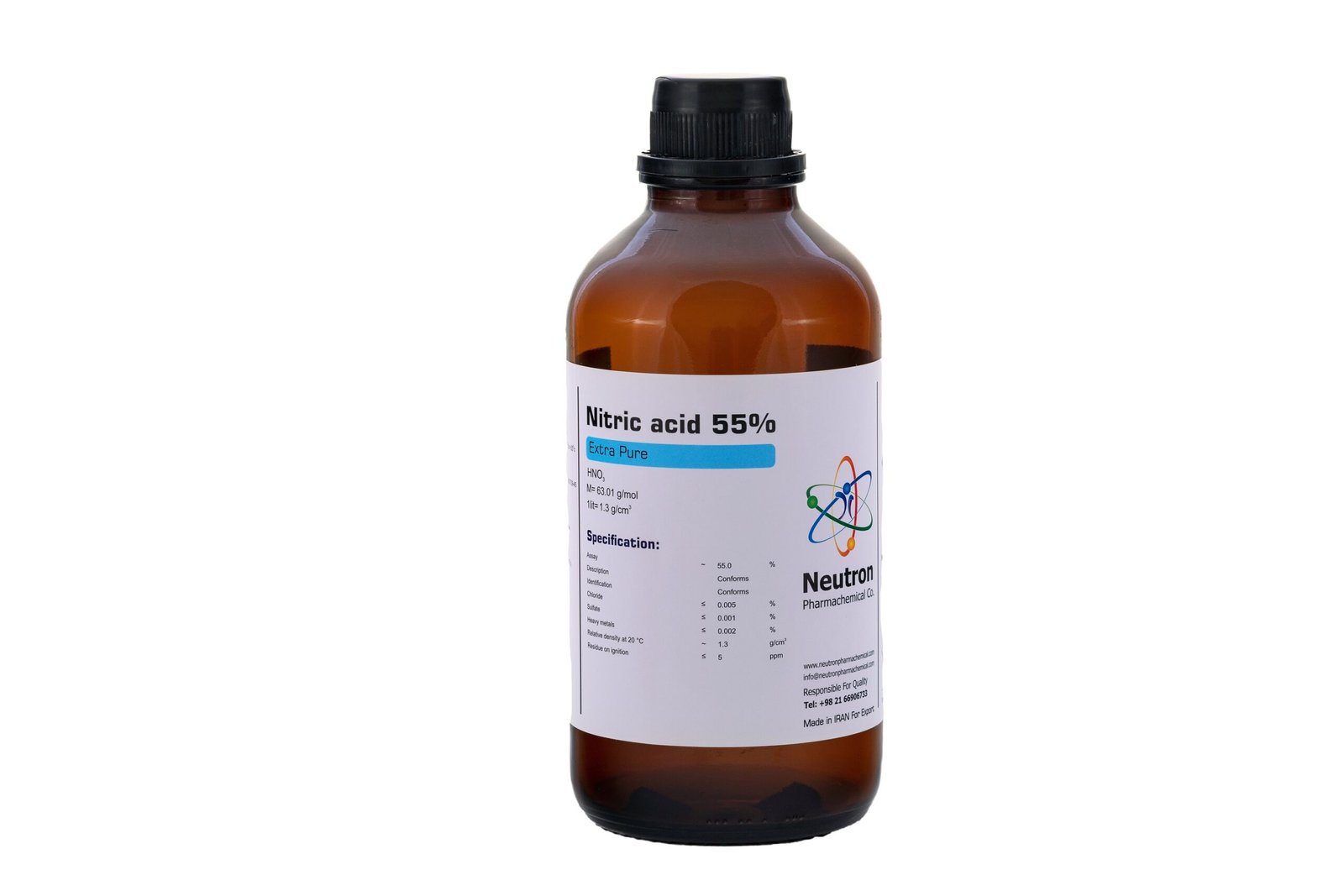
نیتریک اسید 55%
| HS code: | 28080000 |
| Storage: | store at +2°C to +25°C |
| SDS: | available |
| R phrase: | R35 |
| S phrase: | S 23.2-26-36/37/39-45 |
| Odour: | pungent |
| Form: | liquid |
| Color: | colourless |
| Solubility in water: | (20 °C) soluble |
| Boiling point: | 121 °C |
| Melting point: | ~ -32°C |
| Vapour pressure: | ~ 9.4 hpa(20 °C) |
| Assay | ~ | 55 | % |
| Description | Conforms | ||
| Identification | Conforms | ||
| Chloride | ≤ | 0/005 | % |
| Sulfate | ≤ | 0/001 | % |
| Heavy metals | ≤ | 0/002 | % |
| Relative density at 20 °C | ~ | 1/3 | g/cm3 |
| Residue on ignition | ≤ | 5 | ppm |
Nitric acid 55% is a colorless to pale yellow aqueous solution of nitric acid, commonly used in laboratories for its strong oxidizing and acidic properties. At this moderate concentration, it remains highly reactive yet safer to handle than more concentrated forms. It is primarily used in chemical synthesis, analytical procedures, and controlled pharmaceutical processes.
🏭⚗️ Production
Nitric acid is produced industrially via the Ostwald process, which involves the catalytic oxidation of ammonia to nitrogen oxides, followed by absorption in water. The 55% concentration is typically obtained by dilution of concentrated nitric acid with distilled water under controlled conditions to maintain stability and minimize decomposition.
🔬 Properties
Nitric acid 55% has the approximate formula HNO₃ (aq), with a molar mass of 63.01 g/mol for the pure acid. It appears as a corrosive liquid with a sharp, acrid odor. The solution is highly acidic (pH ≈ 0.7), and acts as a strong oxidizer. It reacts with metals, organic materials, and many bases. It is fully miscible with water and decomposes slowly over time, especially when exposed to light or heat.
🧪 Applications
In laboratory settings, 55% nitric acid is used in acid digestion, nitration reactions, and as an oxidizing agent in both organic and inorganic chemistry. It plays a role in preparing pharmaceutical intermediates, cleaning laboratory glassware, and testing metal content in samples. In pharmaceutical processes, its controlled concentration allows for safer use in specific syntheses and pH adjustments, under strict regulation.
⚠️ Safety
Nitric acid 55% is corrosive to skin, eyes, and mucous membranes and can cause severe chemical burns. It releases toxic nitrogen oxides upon decomposition or reaction with incompatible substances. Proper protective equipment such as acid-resistant gloves, goggles, lab coats, and fume hoods must be used. It should be stored in acid-safe containers, away from organic materials, bases, and reducing agents. Handling requires trained personnel and appropriate safety protocols.