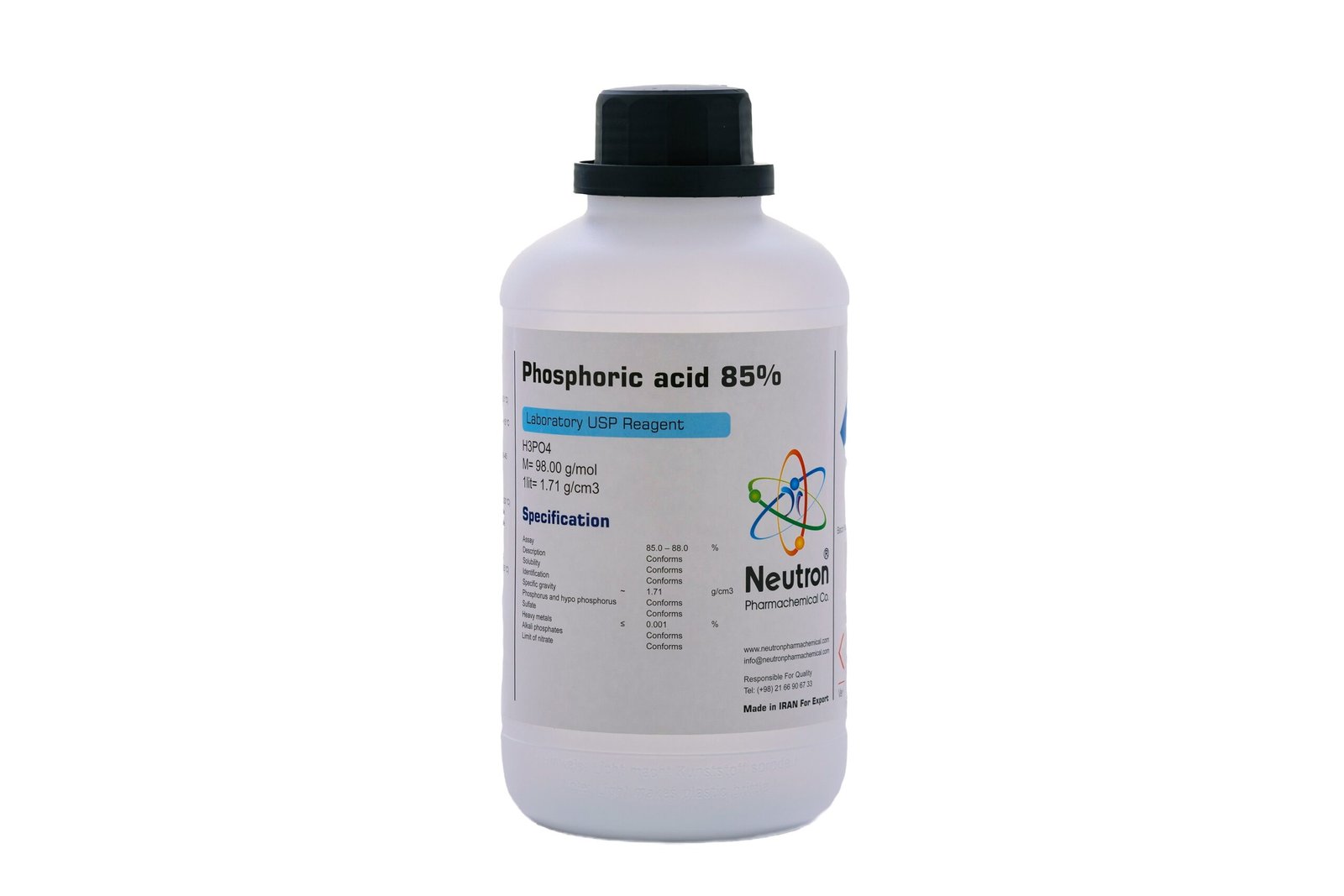
Phosphoric acid 85%
| Formula: | H3PO4 |
| Density: | 1.71 g/cm3 (20 °C) |
| HS code: | 28092000 |
| Storage (temperature): | Store above +15 °C |
| SDS | available |
| R phrase: | R 34 |
| S phrase: | S 26-36/37/39-45 |
| Odour: | odourless |
| Form: | liquid |
| Color: | colourless |
| PH value: | < 0.5 (100 g/l 20 °C) |
| Solubility in water: | (20 °C) soluble |
| Solubility in ethanol: | (20 °C) soluble |
| Boiling point: | ~ 158 °C |
| Melting point: | ~ 21 °C |
| Vapour pressure: | 2 hPa (20 °C) |
| Viscosity kinematic: | 30.5 mm2/s (25 °C) |
| Assay | 85.0 – 88.0 | % | |
| Description | Conforms | ||
| Solubility | Conforms | ||
| Identification | Conforms | ||
| Specific gravity | ~ | 1.71 | g/cm3 |
| Phosphorus and hypo phosphorus | Conforms | ||
| Sulfate | Conforms | ||
| Heavy metals | ≤ | 0.001 | |
| Alkali phosphates | Conforms | % | |
| Limit of nitrate | Conforms |
Phosphoric acid 85% is a concentrated aqueous solution of orthophosphoric acid (H₃PO₄). It is a clear, colorless, odorless, and syrupy liquid that is widely used in food processing, agriculture, industrial manufacturing, and pharmaceuticals.
🏭⚗️ Production
Phosphoric acid is primarily produced via the wet process, in which phosphate rock is treated with sulfuric acid, yielding phosphoric acid and gypsum as a byproduct. The 85% concentration is obtained by removing excess water through evaporation. It can also be produced by the thermal process, which involves burning elemental phosphorus in air and hydrating the resulting P₄O₁₀.
🔬 Properties
Phosphoric acid 85% is a moderately strong acid with a pH around 1.0. It is miscible with water, non-volatile, and has good thermal and chemical stability. It is corrosive to metals and tissue in its concentrated form and acts as a triprotic acid, capable of donating three hydrogen ions.
🧪 Applications
• Food industry: Used as an acidulant (E338) in soft drinks, jams, and processed foods.
• Agriculture: A precursor for phosphate fertilizers like mono- and diammonium phosphate.
• Pharmaceuticals: Used in dental products, anti-nausea syrups, and as a pH adjuster.
• Industrial uses: Applied in metal treatment (e.g., rust removal), cleaning agents, and in the production of detergents and flame retardants.