Potassium sulfate
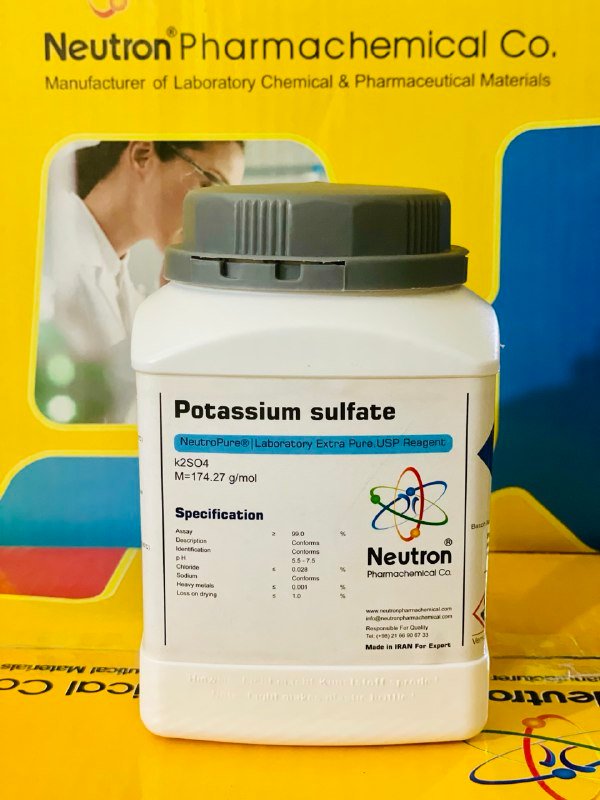
| Formula | K2O4S |
| Chemical formula | k2SO4 |
| Density | 2.66 g/cm3 (20°C) |
| Molar mass | 174.27 g/mol |
| Bulk density | ~1400 kg/m3 |
| CAS number | 7778_80-5 |
| HS Code | 31043000 |
| EC number | 231-915-5 |
| Storage | Without limitation |
| SDS | available |
| RTECS | TT5900000 |
| Odour | odourless |
| Form | solid |
| Color | colourless |
| p H | 5.5 – 7.5 (50g/l 20°C) |
| Solubility in water | 111g/l (20°C) |
| Solubility in ethanol | insoluble |
| Boiling point | 1689 °C |
| Melting point | 1069 °C |
| Assay | ≥ | 99 | % |
| Description | Conforms | ||
| Identification | Conforms | ||
| p H | 5.5 – 7.5 | ||
| Chloride | ≤ | 0/028 | % |
| Sodium | Conforms | ||
| Heavy metals | ≤ | 0/001 | % |
| Loss on drying | ≤ | 1 | % |
Potassium sulfate is a white, crystalline inorganic compound primarily used as a fertilizer that supplies both potassium and sulfur to plants, particularly beneficial for chloride-sensitive crops such as tobacco, potatoes, and certain fruits and vegetables.
🏭⚗️ Production
Potassium sulfate is commonly produced by reacting potassium chloride (KCl) with sulfuric acid (H₂SO₄) in the Mannheim process, which yields potassium bisulfate and hydrogen chloride gas; the bisulfate is then reacted with additional KCl to form potassium sulfate. It can also be obtained from natural minerals like langbeinite or kainite through water extraction and purification processes.
🔬 Properties
The chemical formula is K₂SO₄ with a molar mass of approximately 174.26 g/mol. It appears as a white, odorless, crystalline powder that is soluble in water but insoluble in alcohol. It has a density of about 2.66 g/cm³, is thermally stable, non-hygroscopic, and shows a neutral to slightly alkaline pH in aqueous solutions.
🧪 Applications
Potassium sulfate is widely used as a potassium-rich, chloride-free fertilizer in agriculture. It is also used in the glass industry to enhance durability and clarity, in laboratories as a reagent and source of potassium and sulfur, and in some pharmaceutical applications.
⚠️ Safety
Potassium sulfate is generally considered safe and non-toxic under normal handling conditions. However, inhalation of its dust may cause mild irritation to the eyes, skin, or respiratory system. It is recommended to use protective gloves and masks during handling, and to store it in a cool, dry, well-ventilated place away from moisture and reactive chemicals.